

Are You the One Holding the Relationship Together? Read This.
If you are always the one who plans, smooths things over, remembers, apologizes first, and keeps the peace, you already know the quiet exhaustion that comes with it. You are the stabilizer. And in an imbalanced relationship, being the stabilizer is a full-time job nobody applied for.
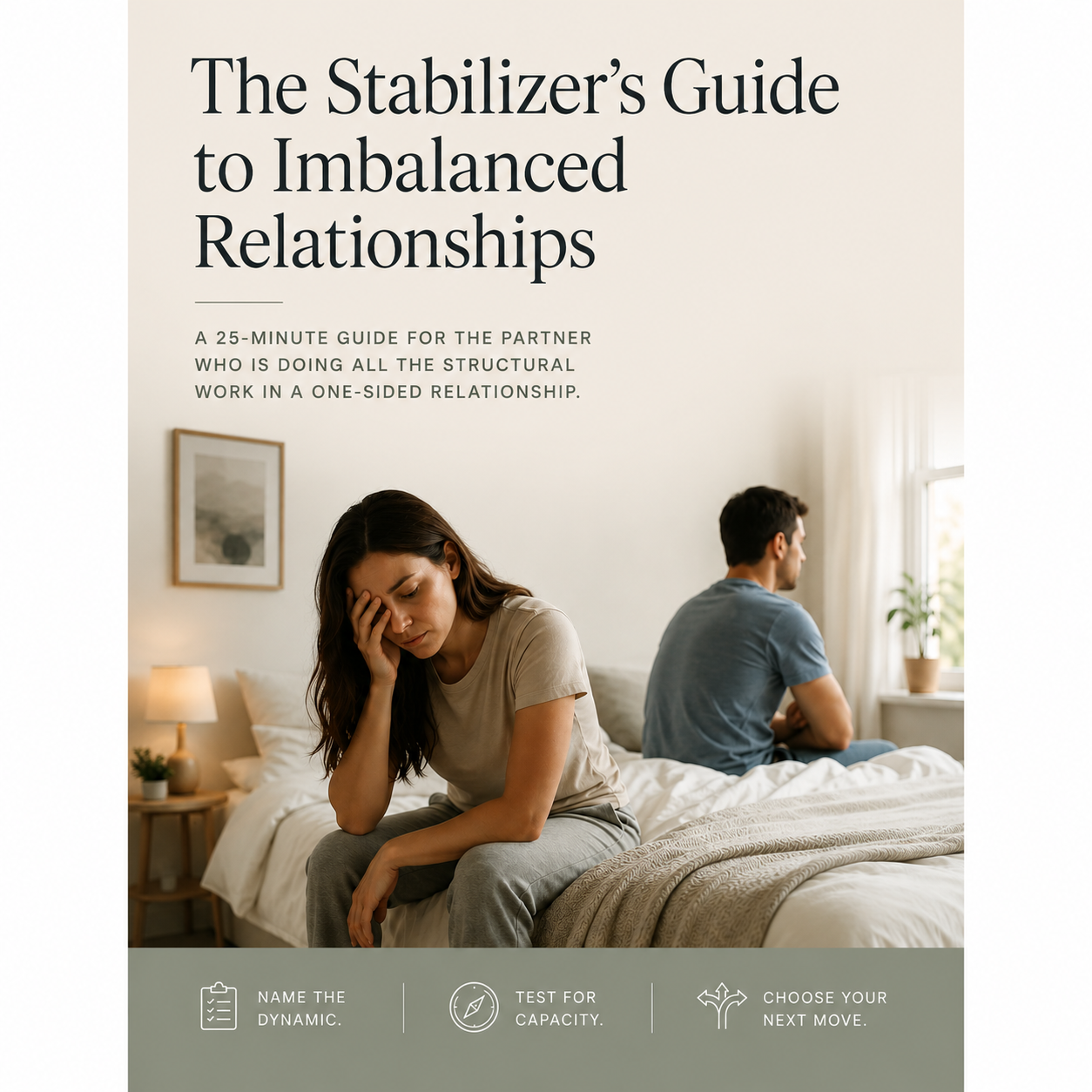
This post breaks down what an imbalanced relationship actually is, how to tell if you are carrying more than your share, and what to do about it. It is also the thinking behind our guide, The Stabilizer's Guide to Imbalanced Relationships, a 25-minute read built for exactly this situation.
What an imbalanced relationship really looks like
An imbalanced relationship is not always loud or obvious. It rarely shows up as one big betrayal. More often it is a slow accumulation of small asymmetries that leave one person doing most of the emotional and logistical work. Signs include:
- You initiate most of the effort. Plans, check-ins, hard conversations, and repair attempts almost always start with you.
- You manage two emotional states. Yours and theirs. You scan their mood and adjust yourself to keep things calm.
- You over-explain and over-apologize. You soften your needs so they land gently, even when you did nothing wrong.
- You feel responsible for the relationship's health. If things are good, you worked for it. If things are bad, you assume it is yours to fix.
- You are tired in a way that sleep does not fix. That is emotional labor, not laziness.
Why stabilizers stay stuck
Most stabilizers are not weak or naive. They are usually capable, responsible people who are good at carrying weight, which is exactly the trap. The more capacity you show, the more gets handed to you. Over time, the relationship quietly reorganizes around the assumption that you will absorb whatever is needed.
Three patterns keep stabilizers in place:
- Competence becomes the cage. Because you can handle it, you are expected to, every time.
- Calm gets mistaken for consent. Your willingness to keep the peace reads as agreement that the imbalance is fine.
- Hope outpaces evidence. You keep investing based on who they could be, not how the relationship actually functions today.
The three-step framework
Our guide walks through a simple, repeatable framework you can use to get clear-headed without spiraling or blowing things up. The short version:
- Name the dynamic. Get specific about what you are actually carrying. Naming it turns a vague heavy feeling into something you can look at directly.
- Test for capacity. The real question is not whether your partner loves you. It is whether they have the willingness and ability to carry their share. You test this with small, clear asks and watch what happens.
- Choose your next move. Based on what the test shows, you decide from a place of information instead of fear. Sometimes that means a real conversation. Sometimes a boundary. Sometimes a harder decision.
What you can do this week
You do not have to overhaul anything overnight. Start small:
- Write down the last five things that required emotional labor in your relationship and note who initiated each.
- Make one clear, direct request instead of hinting, and notice the response, not the promise.
- Stop pre-managing their reaction for 24 hours and see what you learn.
- Talk to one trusted person outside the relationship who will tell you the truth.
None of these are dramatic. They are diagnostic. They show you what is real.
Common mistakes stabilizers make
When stabilizers finally decide to address the imbalance, they often trip over the same predictable mistakes. Knowing them in advance saves you months:
- Leading with an ultimatum. Big threats made in a moment of frustration rarely produce real change and usually trigger defensiveness. Clarity beats drama.
- Asking for everything at once. Dumping months of stored resentment into one conversation overwhelms both of you. Small, specific asks reveal more.
- Mistaking apology for change. Words are cheap and easy to give. Watch what happens over the next two weeks, not what is promised in the moment.
- Going back to over-functioning the second things improve. The first sign of warmth and you rush back to carrying everything, which resets the whole dynamic.
- Keeping it all internal. Stabilizers tend to process alone. An outside perspective is often the thing that finally breaks the fog.
Frequently asked questions
Does an imbalanced relationship always mean I should leave?
No. Imbalance is a pattern, not a verdict. Some relationships rebalance once the dynamic is named and the other person steps up. The point of the guide is clarity, not a predetermined answer. You decide from information, not fear.
What if my partner does not even realize the imbalance exists?
That is extremely common. Many partners are not malicious, they have simply adapted to you handling everything. The capacity test in the guide is designed to reveal whether they will step up once the imbalance is visible to them.
Is this guide therapy?
No, and it does not replace it. It is a practical framework for seeing your situation clearly and choosing your next move. If you are dealing with abuse or a crisis, please reach out to a qualified professional or a support line in your area.
Who this guide is for
The Stabilizer's Guide to Imbalanced Relationships is for the partner doing all the structural work in a one-sided relationship. It is calm, practical, and judgment-free. It will not tell you to leave, and it will not tell you to stay. It will help you see clearly and choose deliberately. It is a 25-minute read, an instant digital download, and yours to keep.
Ready to get clear on where you stand? The Stabilizer's Guide to Imbalanced Relationships walks you through the whole framework. Click here to get it.
SEO keywords: imbalanced relationship, one-sided relationship, emotional labor in relationships, relationship burnout, am I doing too much in my relationship, signs of a one-sided relationship, relationship imbalance, carrying the relationship, emotional exhaustion relationship, relationship advice, how to fix a one-sided relationship, setting boundaries in relationships, when you do all the work in a relationship, relationship dynamics, feeling unappreciated in a relationship, emotional caretaker, over functioning in relationships, relationship self help, healthy relationship boundaries, codependency signs, relationship effort imbalance, when your partner does not try, relationship resentment